Next-Generation Terminal Control with Optergy P442 and Optergy Air
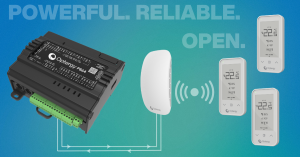
In today’s building automation landscape, combining edge-level control with wireless infrastructure is key to achieving scalable, efficient HVAC systems. The Optergy P442, a BACnet ASC-level controller, paired with Optergy Air’s wireless star topology, delivers a streamlined solution for terminal unit control with reduced network traffic, fast response times, and simplified installation.
Optergy P442: BACnet ASC with Dual Protocol Support
The P442 is a fully programmable BACnet Application Specific Controller designed for VAVs, fan coils, and unit heaters. It features:
- Software-selectable BACnet MS/TP or IP, enabling flexible deployment across legacy and modern networks.
- 4 universal inputs, 4 binary outputs, and 2 analog outputs, ideal for terminal-level control.
- Embedded control logic for autonomous operation, including demand control ventilation and occupancy-based strategies.
By hosting schedules, trends, and alarms locally, the P442 reduces reliance on supervisory controllers and minimizes backbone traffic.
Wireless Star Topology with Optergy Air
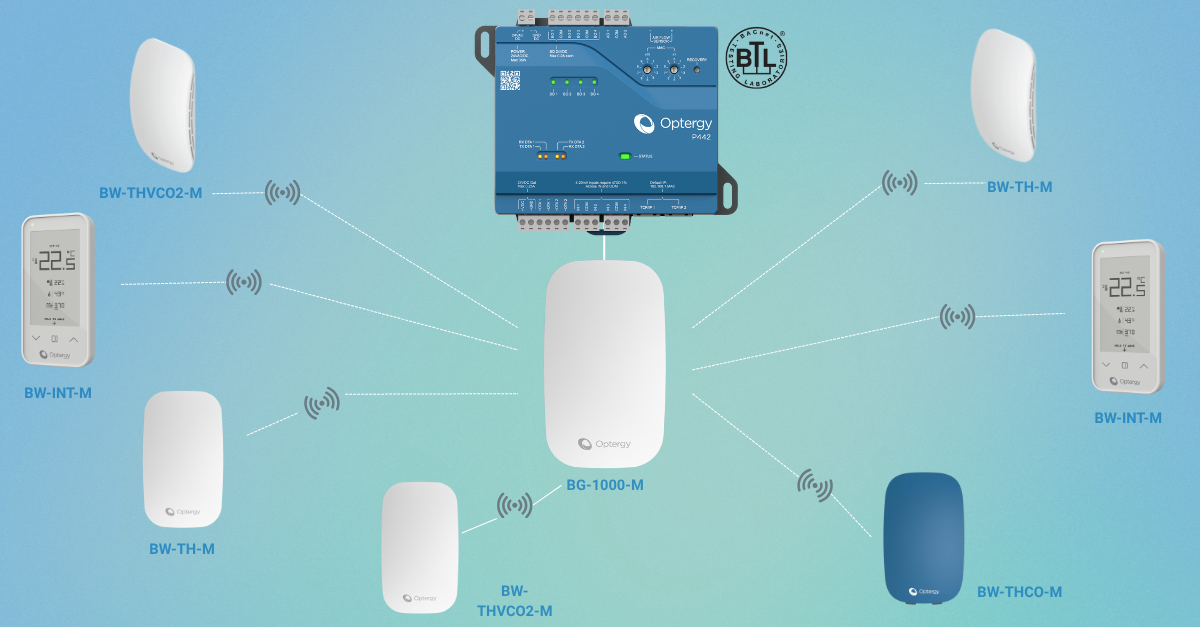
Optergy Air uses a wireless star topology, where each sensor communicates directly with a central gateway. This architecture offers:
- Deterministic communication paths, reducing latency and simplifying diagnostics.
- No relay overhead, ensuring efficient RF bandwidth usage.
- Simple commissioning, with direct addressing and automatic registration.
Beyond installation efficiency, wireless systems like Optergy Air also offer environmental advantages. Studies have shown that when battery-powered devices maintain a long operational lifespan—as Optergy Air sensors do with a minimum 5-year battery life—the overall environmental impact is often lower than wired alternatives. Wired systems require copper cabling, conduit, and labor-intensive retrofits, all contributing to material waste and carbon emissions. Wireless deployments reduce these demands significantly in new builds or tenant fitouts.
Long Battery Life + Fast Update Rate = Better Control
Optergy Air sensors transmit temperature and humidity data every 15 seconds, supporting:
- Tighter control loops, reducing overshoot and improving comfort.
- Improved energy efficiency through precise modulation of dampers, valves, and fans.
- Reliable humidity data for smarter ventilation and IAQ strategies.
This fast telemetry, combined with long battery life, ensures both low maintenance and high-performance control.
Integrated Benefits
- Lower installation costs with minimal wiring.
- Protocol flexibility for diverse BAS architectures.
- Resilient control with terminal-level autonomy.
- Scalable deployment ideal for commercial, education, and healthcare facilities.
- Environmentally efficient infrastructure, reducing materials and long-term waste.
Summary
Deploying the Optergy P442 BACnet ASC with Optergy Air wireless sensors creates a high-performance, low-complexity solution for terminal HVAC control. With localized intelligence, flexible networking, and fast wireless telemetry, this combination supports smarter buildings with lower lifecycle costs, better energy outcomes, and a reduced environmental footprint.